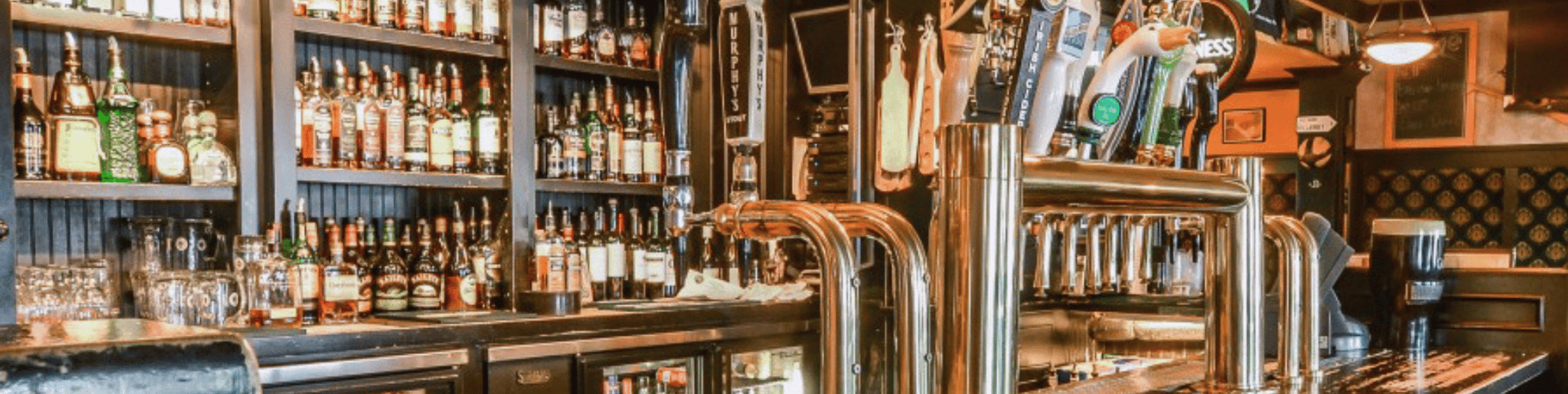

Here is a fact that surprises most people: If you walked into a pub in Ireland and asked for corned beef and cabbage, you would not find it. Not on St. Patrick's Day, and not on any other day. While the dish that has become the defining symbol of Irish-American identity — the meal that fills tables on the 17th of March, the centerpiece of countless family traditions — it is not Irish at all. Not exactly...
It is, in the truest sense, an immigrant dish. Born in the tenements of 19th-century New York City, assembled from the ingredients available to a people who had survived the unsurvivable, corned beef and cabbage is a story about loss and resilience and the way food carries memory across an ocean.
At Nine Irish Brothers, we know that story--our ancestors lived it. And we think it makes the plate taste better.
What the Irish Actually Ate
In Gaelic Ireland, cattle were not food, but rather wealth; a man's herd measured his status and his earnings potential. Cows provided milk, butter, and pulling power for the fields and were sacred enough that they were only slaughtered if they were too old to work; even then, the beef that resulted was the province of kings and the wealthy, not ordinary families.
What ordinary Irish families ate was pork. Pigs were cheap to raise, lived on scraps, and could be slaughtered without the economic loss that killing a cow represented. Bacon and cabbage — not corned beef and cabbage — was the dish that sustained Ireland for centuries, and it is still the traditional meal you'll find in an Irish home today.
The other pillar of the Irish diet was the potato, introduced to Europe in the sixteenth century and quickly adopted as a near-miraculous crop. It grew in poor soil, yielded abundantly, and provided enough calories and nutrition to sustain entire families. By the early nineteenth century, a large portion of Ireland's rural population depended on it almost exclusively.
From those two staples — potato and cabbage — grew one of Ireland's great comfort dishes: colcannon. The name comes from the Irish Gaelic cal ceannann, meaning "white-headed cabbage." The dish is simple and deeply satisfying: potatoes mashed with butter, cream, and either cabbage or kale, sometimes finished with scallions. It was warm, filling, and could be made by any family who had a hearth and a pot. Colcannon was so beloved that Irish folk songs were written about it. It was also used for Halloween fortune-telling — a coin, a rag, or a thimble hidden in the pot, and whatever you found in your serving told your fortune for the coming year.
The Famine and the Ships That Followed
In the autumn of 1845, a water mold called Phytophthora infestans arrived in Ireland and began destroying potato crops. It spread with devastating speed. By 1846, the blight had wiped out virtually the entire harvest. A population that had built its diet around the potato had nothing left to eat.
The Great Famine lasted until roughly 1852. Approximately one million people died of starvation and disease. Another million — and eventually far more — emigrated, crowding onto ships so poorly provisioned and so dangerous that they became known as coffin ships. They arrived in American ports weakened, impoverished, and carrying almost nothing but their language, their faith, and their hunger.
There is a bitter irony embedded in this history that is worth understanding: Ireland had been exporting beef to England, France, and the Americas since the seventeenth century. The British Cattle Acts of 1663 and 1667 had flooded the Irish market with cattle, making Ireland the world's leading producer of salt-cured beef. Irish corned beef provisioned the Royal Navy. It fed the American colonies. It crossed the Atlantic by the shipload.
But the Irish people themselves could not afford to eat it: While they produced the world's most sought-after corned beef, they subsisted on pork, potatoes, and cabbage. Beef was for export. The people who made it went without.
New York, New Neighbors, and the Birth of a Tradition
The Irish who arrived in America settled together, most heavily in New York City, in the dense tenement neighborhoods of lower Manhattan and the Lower East Side. They found themselves living alongside another community of recent immigrants who had also fled oppression in Europe: Jewish families from Eastern and Central Europe.
The Smithsonian has written that the Irish and Jewish immigrant communities shared a remarkable number of parallels — scattered across the globe by persecution, longing for a sacred homeland, discriminated against in America, and bound together by a love of music, storytelling, and community. There was understanding between them, and that understanding extended to commerce. The Irish almost exclusively bought their meat from kosher Jewish butchers.
Those butchers sold brisket — a kosher cut from the front of the cow, relatively inexpensive because it was tough and required long, slow cooking to become tender. The Irish, who could now afford meat for the first time in their lives, found in brisket the nearest available substitute for the salted pork they had grown up eating. They boiled it in a pot with cabbage and potatoes, the way they had always cooked their simple meals back home.
What we call Irish corned beef and cabbage is, at its origin, a Jewish cut of meat prepared by Irish hands in an American kitchen. It is a dish of convergence — two immigrant communities sharing the same streets, the same markets, and eventually the same table traditions. It became so woven into Irish-American identity that Abraham Lincoln chose corned beef, cabbage, and potatoes as the menu for his first Inaugural Luncheon in March of 1861.
Ireland itself never adopted the dish; the homeland continued eating bacon and cabbage. The traditions parted ways at the dock, and they have never fully rejoined.
How We Honor That History at Nine Irish Brothers
Understanding where corned beef and cabbage comes from changes the way you think about making it. This is not a dish to rush. It is not a dish built on shortcuts. It is a dish that deserves respect — because it carries the weight of people who had very little and made something remarkable from what they had.
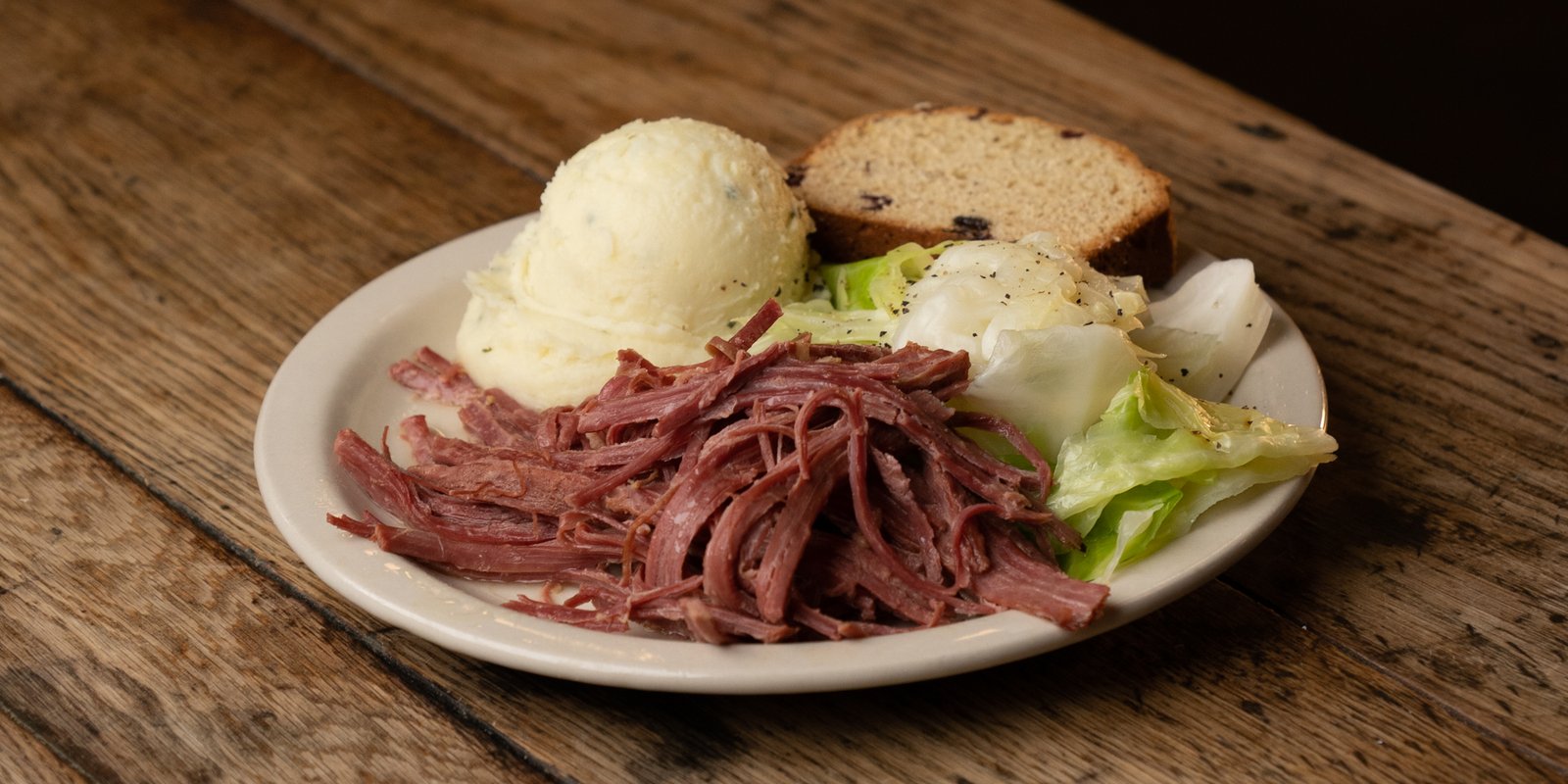
We start with the same whole corned beef brisket we use in our Reuben — slow-cooked until it reaches a state of deep tenderness, then pulled apart by hand. That process takes time, but the result is corned beef with a texture and flavor that a pre-sliced deli product cannot approach: Irregular, yielding pieces with caramelized edges and the kind of savory depth that only comes from low, slow heat and a good brisket.
Alongside the beef comes steamed cabbage, simply seasoned with salt and pepper. (This is a deliberate choice. Cabbage doesn't need to be complicated. It needs to be fresh, properly cooked — tender but not collapsed — and left to speak for itself.) The clean, mild sweetness of good steamed cabbage is the counterpoint the rich, savory beef needs.
The mashed potatoes on this plate are champ — the traditional Irish preparation that connects directly to the colcannon tradition. Champ is mashed potato made with scallions, butter, and cream. It is richer and more flavorful than plain mash, and it carries centuries of Irish comfort food history in every spoonful. When those Irish immigrants in New York put potatoes in the pot with their corned beef and cabbage, this is what they were reaching for — the taste of home.
And then there is the soda bread. Our soda bread is a family recipe unique to Nine Irish Brothers — not something you'll find elsewhere. The O'Bryan family developed it specifically for our menu, and it has been a quiet point of pride ever since. Soda bread is leavened not with yeast but with baking soda, producing a denser crumb with a slightly tangy flavor. Ours carries a gentle sweetness that is designed to play against the saltiness of the beef and the earthiness of the cabbage. It is the final balance — the sweet note at the end of a savory story.
What Our Guests Say
Corned beef and cabbage at Nine Irish Brothers has the kind of following that builds over years of people returning for the same meal, in the same booth, at the same time of year. Guests tell us the corned beef is "super tender and flavorful." They tell us the mashed potatoes and shredded beef together are "delicious." They tell us the cabbage and soda bread are "excellent." And a fair number of them tell us it's the dish they order every time — the reason they came back.
The dish is available as a full order or a half order, which makes it a natural choice for guests who want to explore more of the menu. The half order of corned beef alongside a cup of Guinness Stew is one of our most popular combinations, and one we'd recommend without hesitation.
Come Taste the Tradition
Every great dish has a story. The story of corned beef and cabbage is one of the most human in all of American food history — a story of people who lost almost everything and built something new from what remained. A kosher cut of meat. A handful of cabbage. Potatoes. And the stubborn, enduring warmth of a people who refused to let their table traditions die with the crossing.
At Nine Irish Brothers, we serve that story with slow-cooked brisket, champ mashed potatoes, steamed cabbage, and a slice of soda bread that belongs only to us. Come in any night of the week. You don't have to wait for St. Patrick's Day.